Monday, June 17, 2013

IPM Notes for June 13, 2013


Despite the stormy weather, some work was done. A few Master Gardeners managed  to reach the Winner Farm and see what was happening before the lightening began.  Trap 1 was emptied before lightning and rain drove everyone into the Farmer’s Market shed.

The highlights of the morning's session were:

  • Trap 1 – (Black Cutworm) had 7 moths.
  • Last week’s red color on corn leaves is most likely environmental damage.
  • Sweet corn has been planted and is coming up.
  • Popcorn will be planted next week.
  • There is a new kind of insect trap called a Helios Trap. It is a net trap, but still uses pheromones to attract insects.
  • With the wet weather it is possible that there will be varieties of scab showing up in the wheat heads. It is also called Fusarium and is fungal. Also, if it remains wet in the seed heads, the seeds could actually sprout. About 2 more weeks until harvest.
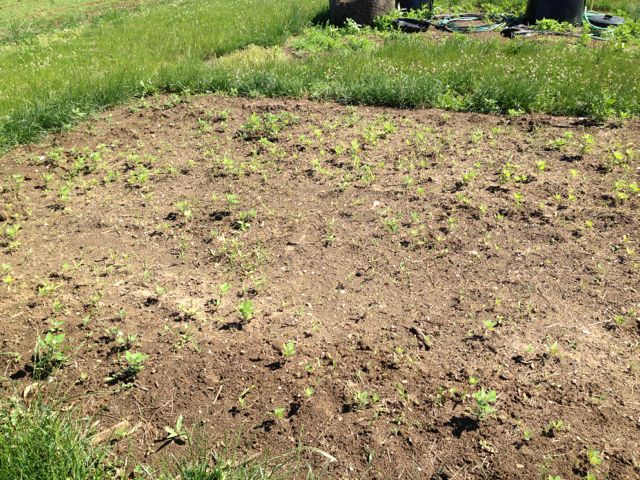
  • In the cover demonstration plot buckwheat and cowpeas have been planted.
  • It was noted that the peppers may be exhibiting nitrogen deficiency after the mulch application.
  • At the next session the terminology associated with describing moths will be reviewed.


Sunday, June 16, 2013

Demonstration Plots - June 11, 2013


Here are the latest photographs of the demonstration plots.

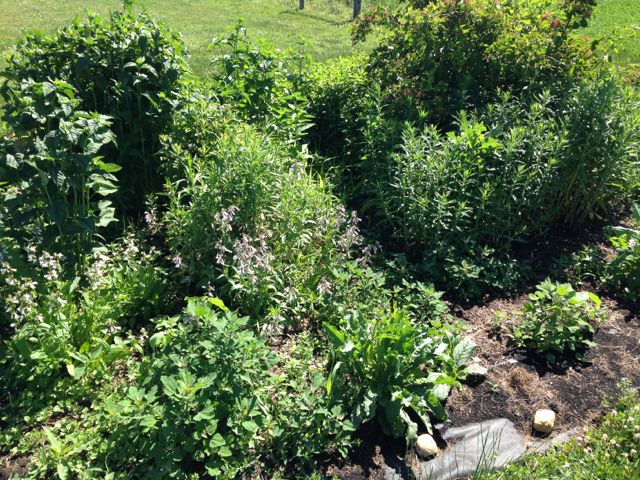
Herb Demonstration Plot


Polinator Demonstration Plot


Hops Demonstration Plot


Blueberry Demonstration Plot


Composting Demonstration Plot


Ground Cover Demonstration Plot


Quinoa Demonstration Plot


Virginia Peanut Demonstration Plot


Tomato Demonstration Plot


Pepper Demonstration Plot
If you see a “work party” in progress, please stop by and talk to our volunteers. They’ll be happy to show you the gardens and answer your questions.


IPM Notes for June 6, 2013

Pheromone Traps Report for Black Cutworm – 
  1. Trap #1- 1 moth.or Corn Ear Worm 
  2. Trap #2- up to 17 moths.for European Corn Borer 
  3. Trap #3 - 1 bumble bee and several beetles.for Fall Army Worm 
  4. Trap #4 - at least 7 moths.

Corn Field


Corn is in stage 3 and approaching stage 4. Field has some weeds reappearing, esp. lamb’s quarter. The upper leaves of the corn appear to be free of paning (cereal leaf beetle) and no instances of buggy whipping were found. Generally, the corn looks good.

Wheat Field


The wheat continues to change color. The seed heads appear full though there is milk present when squeezed. Not many birds were spotted diving the field though white moths are present. The flag leaves look healthy enough with no mildew. We did not see any deeper incursion of possible Army worm damage from the edge of the field.

Oat Field


It was reported that the oat field has been harvested.

Soybean Field


The area that was found nipped last week has expanded to almost double in size. We did not find deer tracks in the field, so continue to surmise groundhog. The soybeans have reached the trifoliate stage.
 

Hayfield Field 

We did find some damage to the tops of some alfalfa plants, but did not find any weevils.

Demonstration Garden Plots

  • Peppers are in and growing.
  • Tomatoes – all support systems are now in place. Tomatoes are growing.
  • Peanuts – peanuts are growing, though there is concern that a couple of plants are possibly exhibiting disease.
  • Quinoa – Quinoa has been weeded of everything except hopefully any quinoa and lamb’s quarter – which it is said to resemble quinoa in its early stages.
  • Blueberries – a nice crop of blueberries have set on.
  • Hops – are growing nicely and have set flowers.


 A special thanks to Roger for compiling the notes from the week's IPM session

Wednesday, June 5, 2013

Pest of the Week - Cucumber Beetle


Cucumber beetles are the most important insect pests of vine crops or cucurbits (cucumber, squash, melons, and pumpkins) across much of the United States. The striped cucumber beetle (Acalymma vittatum) and the spotted cucumber beetle (Diabrotica undecimpunctata howardi) occur in the Northeast. The striped cucumber beetle, typically the most common in New Jersey, feeds primarily on cucurbits, whereas the spotted cucumber beetle has a much wider range of host plants. The immature spotted cucumber beetle is called the southern corn rootworm because it feeds on roots of corn. Cucumber beetles can cause losses to cucurbits by direct feeding on young plants, blossoms, and fruit. They also transmit bacterial wilt, which is caused by Erwinia tracheiphila, a particularly important disease of cucumbers and melons.

Natural History

Adult beetles overwinter and leave their hibernating quarters in the spring when temperatures reach 65F degrees or more. When cultivated cucurbit plants begin to emerge through the soil surface, large numbers of beetles may suddenly appear and feed on the seedlings or crawl into soil cracks in reach of sprouting seed. Beetles soon mate and continue feeding throughout the season. Eggs are laid 8-25 days after mating. Females deposit 225-800 in small clusters or singly into soil cracks at the base of cucurbit plants.

Eggs hatch 5-8 days later, widh larvae spending about 15 days feeding on the roots and stems of fruit that is in contact widh the soil. The pupal period is 6-7 days. The time from egg to adult for The first generation of beetles requires about 1 month and slightly longer for succeeding generations. 

After cucurbit plants mature and cool autumn weather approaches, beetles migrate to wooded, bushy areas, crawling under litter to overwinter. Some may overwinter a mile from the hatching site. In northern states, only 1 generation occurs while 2 or more generations may be produced in the Gulf states.


Cucumber Beetle Larvae

Spotted Cucumber Beetle (Diabrotica undecimpunctata howardi)
Credit:Natasha Wright, Florida Department of Agriculture and Consumer Services, Bugwood.org

Striped Cucumber Beetle (Acalymma vittatum)
Credit: Scott Bauer, USDA Agricultural Research Service

 Management Strategies
  • Crop production practices that promote strong root growth and a vigorous crop will make the plants more tolerant to cucumber beetle feeding. Fertilize properly so plants grow rapidly early in the season. 

  • Early beetle feeding can be avoided by pushing boxes or cones into the ground over the seedlings, open at the bottom and covered with fine netting, as a barrier to the beetles. Remove when plants are established. 

  • All cucurbits except watermelons are susceptible to bacterial wilt, and control is difficult without insecti- cides. Treat early to prevent beetles from feeding on the seedlings and thus reduce the spread of bacterial wilt. It may be necessary to apply an insecticide treatment every 4 to 7 days as needed until vines begin to run to protect plants. 

  • Toxic baits, such as Adios, are commercially available. These baits are a mixture of carbaryl insecticide plus a feeding attractant. Before using any pesticide, read and follow all label directions and restrictions. Observe the proper number of days wait before harvest for each particular crop.


Additional Information

Cucumber Beetles - University of Kentucky

NJAES Cucumber Beetle Fact Sheet 225‎ - Rutgers University

Striped Cucmber Beetle HYG-2139-88 Fact Sheet - Ohio State University

Managing Striped Cucumber Beetle Vine Crops

Bacterial Wilt of Cucurbits - Cornell University

Erwinia tracheiphila - University of Hawaii

Tuesday, June 4, 2013

Demonstration Plots - June 4, 2013


Everyone is encouraged to come to the Master Gardener demonstration plots and see what’s growing.  The demonstration plots are a continuing community project of the Rutgers Master Gardeners of Burlington County, developed to demonstrate, test, teach, learn and enjoy gardening in its many forms in New Jersey's unique climate and soils.  Volunteers maintain the gardens throughout the year using the practices and techniques learned in the Rutgers Master Gardening Training Course and continuing education programs. If you see a “work party” in progress, please stop by and talk to our volunteers. They’ll be happy to show you the gardens and answer your questions.

Here are the latest photographs of the demonstration plots. 

Herb Plot

Pollinator Plot


Hops Plot

Blueberry Plot

Active Composting Plot

Cover Crop Plot

Quinoa Plot

Virginia Peanut Plot

Tomato Plot

Pepper Plot


Sunday, June 2, 2013

IPM notes for May 30th, 2013


Trap report from Lise:
  • Trap 1 (for Black Cutworm): one black cutworm
  • Trap 2 (for Corn Ear Worm): 4 black cutworm (juvenile)
  • Trap 3 (for European Corn Borer): one corn borer
  • Trap4 (for Fall Army Worm): one true armyworm.

Opened our day with a discussion of soil pH. It is a logarithmic scale used to measure acidity of the soil. It ranges from 0 to 14 with 7 being neutral. Logarithmic means that for every change of 1 on the scale there is a change of 10 times in the amount. 0 – 6.9 is acidic and 7.1 – 14 is basic. General agricultural/gardening optimal pH is 6.2 to 6.5 with some plants such as blueberries preferring more acidic soil. Remember that when amending soil with lime to bring down the acidity “Lime Takes Time” – up to 6 months to achieve the full benefit and change. General discussion determined that this should be in a ‘reminder binder’ at the help desk when we are asked to interpret soil test results.

As we walked, we identified the following:

  • Sedge (triangular stock and corms on the roots)
  • Lambs Quarters
  • Jimson Weed
  • Velvet Leaf
  • Wild Geranium
  • Annual Bluegrass

Corn Field
  • Corn is in the 2 collar stage or 2nd leaf stage
  • Cereal leaf beetle is causing some leaf pane-ing
  • There is some environmental damage to the leaves due to heat and moisture.
  • Found some evidence of ‘buggy whipping’ – the main leaf remaining tightly furled. Can clip the top to help it to open up.
  • We examined the inside of a corn plant – where at this stage you can see all the leaves and even the silk that the plant will have in full maturity. Very beautiful.

Wheat Field
  • The wheat is starting to turn. Probably ready for harvest in another month.
  • We found Septoria tritici and Powdery Mildew. The mildew has slowed its growth in the heat.
  • Cereal leaf beetle continues.
  • Birds are swooping and feeding in the field.
  • Possible Rust beginning.
  • Flag leaves seem healthy enough to complete filling of the ears.
  • Ears are in the milk stage and almost finished forming.
  • We found head stalks clipped as in Army Worm damage at the edge of the field in one small area. We were unable to find the worms at the base of the plants. However, we did find one in the trap. This is a concern.
  • Because the crop is set the strategy is one of protection.

Soybean Field
  • Soybeans are not yet in the 1st trifoliate leafing.
  • We found an area at one corner of the field that looked very barren. Upon examination, it showed that the seeds had germinated, but the plants have been nipped.
  • First, we looked for slug evidence such as trails.
  • Then we discussed rabbits, groundhogs, and deer.
  • We have a groundhog burrow close by and deer have been seen in the alfalfa field.
  • Continue to monitor.

Demonstration Gardens

Tomatoes – stakes were brought to complete the trellis.

Peanuts – peanuts did not germinate, so plants were purchased and planted in the plot.

Quinoa – still not sure of germination since young plants resemble Lamb’s Quarters.  We think we have some Quinoa germinating.


A special thanks to Roger for compiling the notes from the week's IPM session.