Tuesday, July 9, 2013

IPM Notes for June 27, 2013


Pheromone Trap Reports

Trap #1, Black Cutworm – Earwig – 1; black cutworm – 1; European chafer – 1; lady bug – 1.

Trap #2, Corn EarWorm – Corn earworm – 2; noctuid – 5; European chafer – 1.

Trap #3, European Corn Borer – Bumble bee – 26; European chafer – 1; corn rootworm – 1.

Trap #4, Fall Army Worm – Fall armyworm – 2; cereal leaf beetle – 4.


Setting pheromone trap
Helios Trap Contents

earwig – 3
bumble bee – 4
striped cucumber beetle – 1
cabbage looper – 1
Examining contents of helios trap
Field Corn

  • All the rain we are having is draining the soil nutrients. Some corn is firing, leaves yellowing at bottom, brown (dead) in middle of leaf. Firing starts with an inverted “V” in the leaf. When loosing nitrogen, leaves are yellow and green. When the stalk is getting yellow, which will weaken it, the stalk will snap off when the weight of the corn is on it. 50-60 pounds of nitrogen were put down the weekend of June 22.

  • Corn does not grow in temperatures over 90 degrees. 

  • Corn is at 8 leaf stage (V-8 – vegetative growth 8). 

  • When hail hits corn, it strips the leaves completely and the corn will have no crop. 

  • Reddish color brace roots were observed on the top of the soil and over the root ball. These hold the corn in the soil.

  • Insects damaging to corn: Flea beetle – causes Stewart’s Wilt, usually when corn is under a foot high.

  • Cereal leaf beetle – feeds on veins causing slits; if there are 10 or more per plant, there could be severe damage to the corn. Cereal leaf beetle is usually on wheat; migrating to corn and now laying eggs on leaves.

  • Overall, corn looks good


Popcorn
  • Two varieties, red and yellow, planted next to field corn a few days ago. 

  • The wet spots are showing saturated soil causing nitrogen to leach and the corn will not germinate.

Sweet Corn
  • Sixteen rows of corn were planted; each a different variety.

  • To estimate number of corn plants per acre: measure 17.5 feet and count the number of plants in that space and count the number of 17.5” rows. Multiply that by 1000. (25 plants in a 17.5” row = $25K plants/acre; if 21 plants = 21K plants/acre)

  • The sweet corn is planted in time blocks so it produces corn for the market each week.

  • The large space between the rows is so the corn can be fertilized.

  • Silver Queen corn no longer exists but the name is synonymous with sweet corn. Many varieties have replaced silver queen such as Argent or Supersweet which are not know to the public; so, for marketing purposes farmers advertise they are selling Silver Queen. These new varieties have a gene that keeps it sweet longer (7-10 days) so it stays fresher/sweeter in supermarkets.

Soybeans
  • Some plants have bacterial disease with the yellowing.

  • Nodules on roots are pink 

  • Plants are at 5 leaf stage (V-5).

  • If weather gets really hot soybeans abort their flowers; when it is cooler they will flower again. 

  • Soybeans flower by the amount of daylight and shut down when the days are shorter. They have maturity groups. The group range in the Burlington County area is 2.8 to 4.2; 2.8 beans are ready in September and 4.2 are ready in October.

Wheat
  • Not resprouting yet; the radical is not coming out. If there is sponginess is in the grain, wheat is not ready to be harvested. The grain must be hard. 

  • Awn wheat has spikes (hairs) on each grain. Deer do not like to eat it with the spikes sticking them in the face. There are two kinds of wheat – awn and awnless.

  • When wheat is harvested, it is sent to market in bushels. An average bushel weighs 60 pounds; it may be lighter 5 pounds or so because of rain causing mold spores and micro toxins on the wheat. Mold spores cause the wheat heads to be empty of grain so the bushel is lighter and must be mixed with good wheat. Some micro toxins are toxic to humans and animals.
  •  Mold spores on the wheat cause the top of the plant to be darker, it has no grain, there are no roots and the stalk is hard. Several plants were noted with the darker tops.


Demonstration Gardens
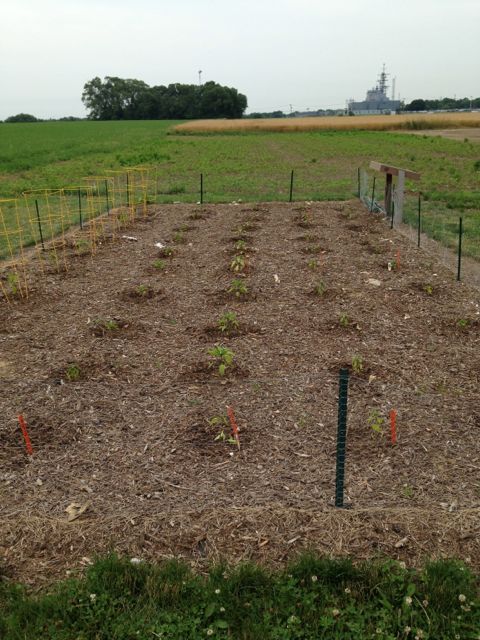
  • Peppers like to dry out so the mulch was pushed away from the plants. The leaves were sprayed with Epsom salts which makes magnesium and greens them. Use 1 teaspoon per gallon of water. Spray once or twice only per season.

Pepper plants
  • Tomatoes should not be watered with Miracle Grow. It makes the plants grow tall without fruit. On the tomato insect sticky paper were a slug and Syrphid flies (hoverflies). Hoverflies help pollinate. Leafhoppers on the plants suck the sap out of the leaves and cause them to curl. Several plants had curled leaves. Leafhoppers spread viruses and tomatoes are susceptible to viruses. Leafhoppers love alfalfa and tomatoes and hops are close to alfalfa. Of the three systems used for tomatoes, the stake or trellis is nice for picking. This system is used commercially. Suckers should not be pruned from the tomatoes. As the plants grow, additional string rows should be added to the stakes. The effect of the straw laid around the tomatoes should be checked regarding disease on the plants.

Examining tomato demo plot
  • Hops are yellowing from leafhopper damage.

  • Quinoa seed replanted in half of the garden.


Special thanks to Marylin for the IPM notes and Ramona for the photographs.


Wednesday, July 3, 2013

Too Much of a Good Thing

June has been a very wet month in New Jersey.  Statewide the average rainfall was 9.75", a state record for any June since 1895.  Frequently, plants in wet and soggy soils exhibit the same symptoms as plants in drought conditions.  It's not unusual to see plants "wilt" on the first  sunny day after a prolonged period of cloudy wet weather.

Plant cells respire and need oxygen to survive and grow.   Plant cells must get oxygen from the air that is close to the cells. The concentration oxygen in the soil is not as high as oxygen around us.  If soil become saturated with excess water. the excess water in the soil forces out soil air. When there is less air available, the oxygen is rapidly used and becomes inadequate for good root growth. Also, in very wet soils organic matter begins to decompose and this process also further depletes oxygen in the soil environment.

In addition to root problems other diseases get established on plants during wet periods.  Many foliar  diseases may form during this period.  Close observation of your landscape and plants is important after an excessive wet period.  If any dead spots, die-back, leaf spots or other disease problems become apparent, whatever the plant, prompt action is important to prevent more severe damage.

Here are some tips for dealing with too much rain in your garden:
  • Cut off or cut back on automatic irrigation systems during periods of heavy rain.

  • Keep gutters, downspouts, ditches, drainage grates and culverts clear of debris so water can move.

  • Channel flooded waters away from garden beds and plants in the landscape by digging temporary small trenches so standing water will run away from the roots of plants that are not tolerant of “wet feet.”

  • Make sure all drainage holes in containers are clear and water can move through the pots.

  • Empty pot saucers regularly or remove during times of excessive rain to prevent containerized plant roots “standing in water.”

  • Consider installing a rain barrel to catch and recycle this natural resource. This was once a common practice and there are many home “rain barrel” kits and instructions on the internet.

  • Consider installing a rain garden in those areas of the yard that tend to hold water during heavy rainfall. 

Additional Information

Office of the New Jersey State Climatologist at Rutgers University

Rain Gardens - Rutgers University

Stormwater Management in Your Backyard

Rain Barrels - Rutgers University

Phytophthora Root and Crown Rot - UC Davis IPM Online

Tuesday, June 25, 2013

Pest of the week - Downy Mildew

Downy mildew causes foliage blights and distortion. Although its name sounds similar to powdery mildew, downy mildew occurs during different environmental conditions and it is managed differently.


Photograph of Downy Mildew
Squash Cucumis pepo - Courtesy University of Georgia


Natural History

During cool wet weather, downy mildew can occur very rapidly and is difficult to control. Some of the greenhouse crops prone to infection include: snapdragon, salvia, alyssum, pansy, rose, rosemary, and ornamental cabbage. Perennials susceptible to downy mildew include aster, coreopsis, geranium, geum, lamium, potentilla, veronica and viola. 

Primary infections in the field or garden generally come from sporangia (spores) produced on southern-grown crops and carried progressively northward on moist air currents during the spring and summer.

The sporangia are disseminated locally from plant to plant and from field to field by splashing rains, moist air currents, insects, tools, farm equipment, the clothing of workers, and through the handling of infected plants. Heavy dews, fogs, frequent rains, and high humidity favor infection and rapid multiplication of the pathogen


Symptoms can be confused with other plant problems. Leaves may become mottled and yellowed, resembling nutritional deficiencies. On some plants, downy mildew infection may look similar to injury from foliar nematodes. In both cases, angular lesions are bounded by leaf veins. However, downy mildew infection results in a soft, fluffy gray, brown or purple fungal sporulation developing on the underside of leaves. On coreopsis, the fungal sporulation is white.

Symptoms can also vary depending upon the host plant. On snapdragons, infected plants are yellow and stunted. You may see downward leaf curling on the young seedlings. On salvia, angular yellow blotches can be seen between the leaf veins. On pansy, leaves turn mottled and off-color with purple blotches. Pale green or yellow patches develop on geum. Purplish patches occur on lamium and veronica. On roses, leaves develop angular dark purple to black areas and may turn yellow and drop.

Management Strategies

To manage downy mildew, first “manage the moisture”: space plants to ensure good air circulation and rapid drying of foliage after irrigation. 

Choose planting sites with good air movement and without shading. Avoid overhead irrigation in early morning when leaves are wet from dew or late in the day when leaves will not have an opportunity to dry before dew forms. Maintain ample but not excessive nitrogen fertility.

Practice good sanitation techniques. Discard all diseased plants as well as plant debris that may harbor spores, and control weeds that may be another source of downy mildew inoculum. 

Protect susceptible crops during cool, wet weather with preventive fungicides. Active ingredients labeled for control of this disease include azoxystrobin, Bacillus subtilis, copper, dimethomorph, fosetyl-Al, kresoxim-methyl, mancozeb,phosphite, trifloxystrobin, and triadimefon + trifloxystrobin (Armada). To reduce the possibility of the development of fungal resistance to some of the newer systemic fungicides with single or few modes of action, rotate these chemicals with protectants such as mancozeb. 

Avoid the sole use of any fungicide for extended periods of time when other reliable products are available, and refer to label for timing, host plants, and rates. 


Additional Information

Plant and Pest Advisory: Downy Mildew in Ornamental Plants - Rutgers University

Cucurbit Downy Mildew Forcasting - North Carolina State University

Botrytis or gray mold - Penn State University

Downy Mildew - University of Connecticut

Downy Mildew - University of llinois

Fun Facts about Fungi - Utah State University

Monday, June 24, 2013

IPM Notes for June 20, 2013


Pheromone Traps Report
Trap #1 - Black Cutworm – nothing to report. 
Trap #2 - Corn Ear Worm – many small moths and 1 large moth.
Trap #3 - European Corn Borer – it was full of bees – at least 33+. We do not know why the  bees are being attracted to this pheromone.
Trap #4 - Fall Army Worm – 8 moths, 4 beetles.


Helios Trap
Nothing to report. Raised the level of the trap to coincide with the corn.


The day's session was focused on weed identification. Here is a list of what was noted:
  • Pennsylvania Smartweed (it is flowering)
  • Water Pepper
  • Yellow Wood Sorrel – it looks like clover but is not in the clover family; toxic.
  • Mare’s Tail
  • Amaranth – both Spiny and Red Root; sometimes called Pigweed.
  • Curly Dock – now seeding
  • Velvet Leaf
  • Plantain
  • Wild Geranium
  • Wild Pansy
When identifying grasses it is best to use a dichotomous key and a hand lens, so that you may be able to identify such features as collars (ligules), auricles, hairs, sheaths, etc.

Report on the Demonstration Plots


  • Hops are looking very good.
  • Blueberries - The plant are in fine shape – no deer damage. Fruit is ripening.
  • Cover Crop - Buckwheat and Cowpeas are both up and growing.
  • Virginia Peanuts- Peanuts are blooming. Will watch for formation of the stems out of the flower/ovary to grow the actual peanut underground.
  • Peppers - The pepper plants are showing stress from the rains. Anywhere from 5” to 8 ½”. Several of the peppers have died. Nitrogen is being washed down below the roots by the rain.  The peppers may need a foliage application of nitrogen and magnesium.  The mulch that was applied is now holding the moisture as well as depleting the nitrogen.
  • Quinoa – We are not sure if we have ANY plants at all.


Report on the Various Crops

Hay Field
Second cutting is down and drying

Soybeans
The soybeans are being grazed – probably groundhog and deer. There are deer tracks across the field and across the corn field. There are two groundhog burrows adjacent to the field. The soybeans have started fixing nitrogen in nodules on the roots. This is good. 

Nodules on soybean roots

Sweet Corn
Ray has planted 16 varieties of sweet corn. The corn is up. There is some flood damage (low lying areas) in the field. Also noted was evidence of birds pulling up the young plants to eat the seed.

Field Corn
The field corn is showing some nitrogen deficiency. Bottom leaves are showing a V pattern of yellowing along the outer edges to the tip. This is indicative of the plant stealing from itself and is called “firing”. Farmer will make one more fertilizer application with a tall tractor.

Wheat Field
The wheat is mature and is now drying to the proper moisture content. We estimate another ten days to harvest. Because of the wet weather, we are looking for mildew and fungus – especially head scab or fusarium.

Because there is no more tender plant material in the wheat field, the cereal leaf beetle is moving to the corn. If there is any Army Worm, it will also. The cereal leaf beetle has been seen, but there is little evidence of the Army Worm.


Saturday, June 22, 2013

Demonstration Plots - June 18, 2013

Showing progress.  Here are latest photographs from the demonstration plots.  When walking through the demonstration plots, if you see a “work party” in progress, please stop by and talk to our volunteers. They’ll be happy to show you the gardens and answer your questions.

Herb Demonstration Plot

Pollinator Demonstration Plot

Hops Demonstration Plot

Blueberry Demonstration Plot

Active Composting Plot

Ground Cover Demonstration Plot

Quinoa Demonstration Plot

Virginia Peanut Demonstration Plot

Tomato Demonstration Plot

Pepper Demonstration Plot


Friday, June 21, 2013

Pest of the Week - Four-lined Plant Bug

Recently, the four-lined plant bug was spotted during an IPM session at the Burlington County Community Agricultural Center.  The four-lined plant bug, Poecilocapus lineatus which is easily identified by the four black strips running down its back, has a wide range of hosts including: fruits, vegetables, flowers, herbs, and cucurbits. The associated damage consists of spots that look similar to fungal disease spot and can be misidentified as such.  


Adult Four-Lined Plant Bug - Courtesy Purdue University

Natural History

During the fall, the banana shaped eggs are laid at right angles in vertical slits measuring 2 to 3 in. along the plant's stem. They are usually not laid individually but instead are laid in groups of six or more. The eggs will over winter and hatch in May or late June just after the plant's foliage emerge. 

Nymphs will remain near their hatching site and feed on the upper side of leaves removing the plant's chlorophyll. After advancing through five molts in a period of about six weeks, the four-lined plant bug will have matured to an adult form. Adults will feed, moving from plant to plant, for approximately one month before mating; adults will not overwinter, and there is only one generation per year.

Feeding by both adults and larvae may cause stippling on leaves - spots of discoloration that may turn from yellow to brown to black. Holes may develop in leaves when heavy infestations occur. Plants are not, however, killed by this bug.

Four-lined Plant Bug Damage- Courtesy Purdue University


The four lined plant bug hides under leaves and may be difficult to detect. Look in May and June for signs of stippling on leaves. 


Management Strategies

Least toxic methods of control for ornamentals and edibles would include insecticidal soap, the dormant and summer weight oils and where feasible, removal of egg masses by selective pruning. Authorities say egg-laying sites are easily visible after leaves drop in autumn.


The use of a trap crop is another possible control method to keep the four-lined plant bug away from the crop. Mint is highly attractive to this pest and can be effectively used as a trap crop. The four-lined plant bugs will choose to feed on the mint instead of other nearby plants. Place a barrier, such as a tile, around the mint to prevent the spread of roots. Once the crop is large enough to withstand damage caused by this pest, the mint can be removed.


Whenever using insecticides, be sure the insect you want to control and the plant you are using it on are both listed on the label.


Additional Resources

Four Line Plant Bug - University of Connecticut 

Four Lined Plant Bug Slides - University of Minnesota 

Vegetable MD Online- Cornell University

Greenindustry - University of Wisconsin - Extension