Wednesday, September 4, 2013

Notes from August 22, 2013

Some general observations:
  • Mildew on cucumbers
  • Parasitic wasp larvae on dead tomato hornworm
  • Cercosporia on grapes
  • Birds in the corn fields
  • Ragweed shedding pollen

Pheromone Trap Results

Change pheromones in traps today

Trap #1 - Black Cutworm
1 black cutworm moth and 1 sap beetle

Trap #2 - Corn Earworm
2 noctuids, 4 sap beetles, 4 indeterminate insects

Trap #4 - Fall Army Worm
1 sap beetle

Bad year for bugs and a great year for plant diseases


Field Corn
Corn is in the dent stage with approximately one month to harvest. The corn plants are beginning to die back so kernels can dry. Because of the open ends on the ears we are seeing mold starting in the ears. If these lead to mycotoxins then the corn may not be useful for feed.


Corn smut

Popcorn Field
Both varieties are fully tasseled. We are seeing smut fungus in some of the tassels. There is some firing on the lower leaves showing nitrogen deficiency. We found a rootworm beetle that has come up to feed on the silks. Also found a brown marmorated stink bug.

We found some small caterpillars eating the leaves of an amaranth plant.

Wheat/Soybean Field
We are now seeing blooms – the plants have moved into the reproductive stage. There are no pods. We found Soybean Aphid – an aphid that is exclusive to soybeans. We also found ladybugs and lacewings. This infestation of aphids may be severe enough to warrant spraying.


Sweet Corn Field
The sweet corn has been harvested and evaluated. There are still ears available for gleaning. The plan is to disc under the corn and plant a cover crop. There is a lot of sap beetle present in the remaining ears.

Hay Field
Was cut today for Third cutting. Leaf hoppers are moving out – to any nearby crop.

Soybean Field
Growing along nicely. Evidence of Cercosporia and thrips.


Soybean Aphids

Demonstration Garden


Tomatoes – Supersonic yield is ahead of Ramapo yield. Potato beetles found (and crushed).


Tomato hornworm with wasp eggs


Peppers – show signs of bacterial spotting and thrip damage. Otherwise they have recovered well and are producing peppers.

Peanuts – are pegging


Peanut Pegs


Cow Peas – have very few pods so not likely to reseed itself. However it is an excellent cover crop allowing few weeds and filling in all spaces.
Buckwheat – our lesson learned is that buckwheat is density sensitive and would require better seed rate monitoring. However, surviving buckwheat is maturing and reseeding itself.

New plant – Path Rush. It looks like a clump of grass but is really in the rush family. It is sometimes called wire grass because of its tough stems. It has tiny flowers clustered at the stem tips. It grows in wet conditions but also likes compacted soils. In New Jersey it can be a wetland indicator species.


 Special thanks to Roger for the notes and Ramona for the photographs.


Saturday, August 24, 2013

Dung beetles are saving the world!

A recent  article published in Entomology Today discusses a recent study by scientist in Europe which indicates that dung beetles living in cow manure may reduce the emission of methane.  To read more, click the link below:

Dung Beetles are saving the world from global warming


Friday, August 23, 2013

The Naming of Plants

Today I received an interesting blog update from the Cambridge Library Collection (CLC).  The CLC reissues scholarly books that are out of copyright and of lasting value.  A recent blog posting from the CLC discussed the naming of plants and I thought everyone would find it entertaining.  The link for the blog is given below.

Cambridge Library Collection - The Naming of Plants


Thursday, August 22, 2013

Pest of the Week - Spiny Amaranth or Spiny Pigweed

Amaranth coming from the Latin amarantus is an imaginary flower that is said never to fade.  While spiny amaranth (Amaranthus spinosus) or spiny pigweed is one of the most common weeds found in fields and pastures and also seems never to fade.

Spiny amaranth (Amranthus spinosus)


Natural History

Spiny amaranth is an annual pigweed. A member of the Amaranthaceae family which includes other plants such as joyweed, pigweed and cock's comb.  The Amaranthaceae are mostly herbs and rarely shrubs or small trees comprising 65 genera and 900 species.


Spiny amaranth is an annual pigweed and can be as tall 5 feet.  Its stems and leaves are hairless and can have a reddish tinge.  The leaves are alternate and oval to egg shape. Spiny amaranth plants also have a pair of short spines at the base of leaf petioles.

Some pigweed plants(Amaranthus palmeri) are edible.  The use pigweeds as a crop is well documented.  The Aztecs cultivated amaranth as one of their crops.  They made a  dough out of milled amaranth and toasted corn seeds mixed with honey or maguey sap.  The dough was formed into idols for various religious festivals.  However, some pigweeds have been associated with nitrate accumulation is livestock and they considered toxic to cattle, goats and sheep.

Management Strategies

Mowing can suppress spiny amaranth growth.  However the plant will bounce back if mowing is not maintained. For smaller stands of weeds, manually remove plants before flowering occurs and seeds are produced.  Herbicides can be used on larger areas as a supplement to a cultural control program, but not as a replacement for a cultural control program.

Additional Information

Spiny Pigweed - Rutgers University

Pigweed - American Indian Health and Diet Project

Amaranthacaea - University of Hawaii

Hay Crop and Pasture Weed Management - University of Tennesse


Tuesday, August 20, 2013

IPM Notes from August 15, 2013

Pheromone Trap Results

Trap #1 - Black Cutworm
The trap had fallen to the ground due to wind. The trap contained 1 bumblebee, 1 ladybird beetle, and 1 black cutworm moth.

Trap #2 - Corn Earworm
1 click beetle, 5 noctuids, 1 crane fly, 1 unidentifiable beetle, and 3 corn earworm moths

Trap #3 - European Corn Borer – Inactive

Trap #4 - Fall Army Worm
4 sap beetles, 1 fall army worm moth


Helios Trap 
Inactive – display/demonstration only

Popcorn Field
Birds are sitting on the tassels and breaking them. We did not find evidence of borers though they are present in the sweet corn. Tassels are out on the early variety, but ears and silks are slow to develop. We noticed this in both the field corn and the sweet corn. Too much water is a different kind of stressor on the crop. We found corn smut on one of the tassels. It was noted that while this is a fungus it is also considered a food delicacy in some cultures. Popcorn harvest is being projected for late September or early October.

Note: Many of the cornstalks in all the corn fields are exhibiting purple stain and black stain on the stalks. These are bacterial diseases that are not currently threatening to the crop but are easily seen. Moisture from the frequent rains has been getting between the leaf and stalk, providing a nice moist environment for bacteria to grow. If that bacteria were to move to the ears and shucks, that would be a problem for sweet corn consumers who would reject it as visually unappealing. Popcorn, because of its harder hull is least affected. Field corn is affected only when the bacteria is actually producing mycotoxins in the ear which renders the crop inedible.

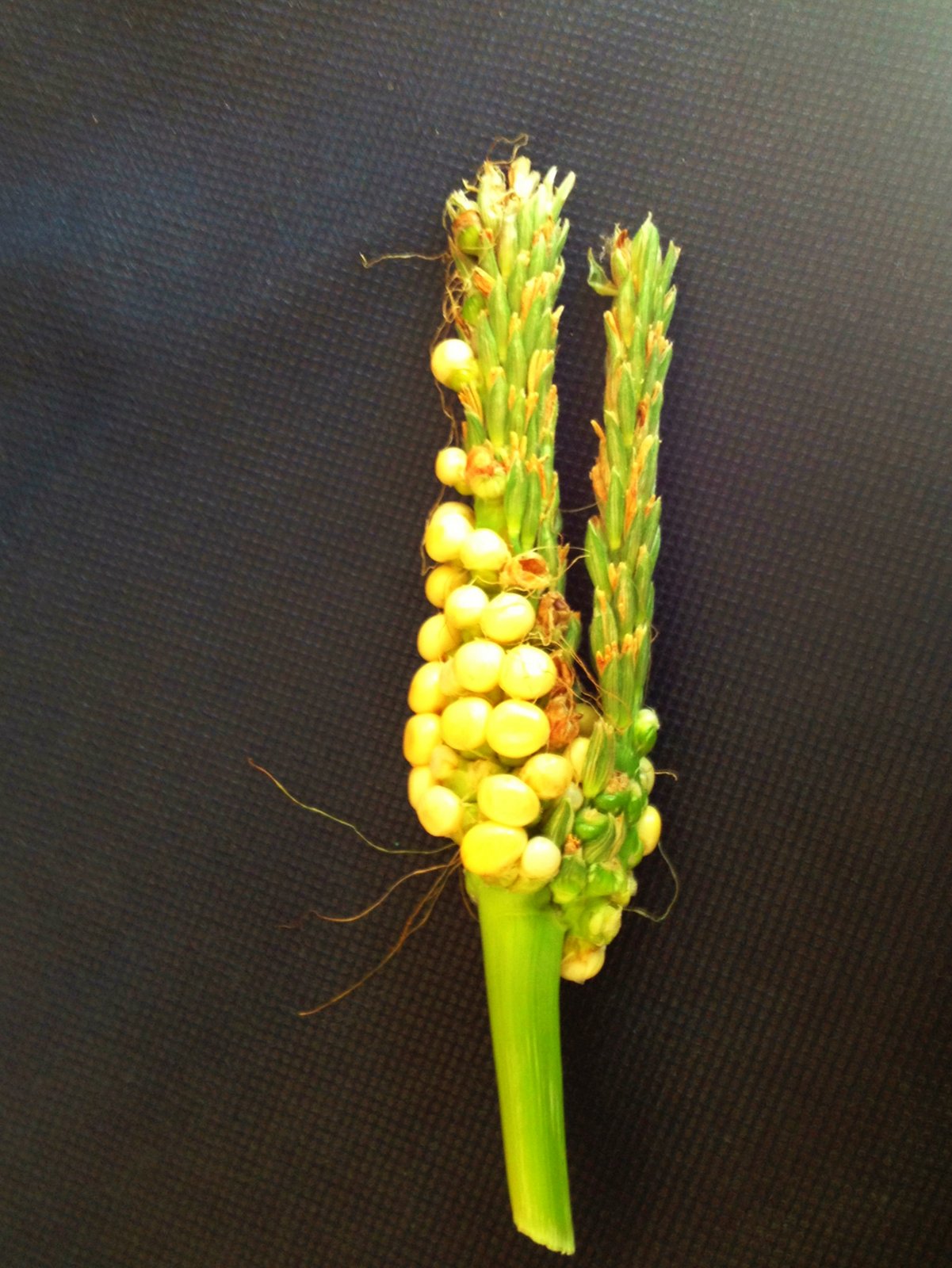
Corn Mutation


Grain Corn Field
Grain corn is in the dough/early dent stage. The milk ring is present and the kernels are still receiving nourishment from the plant (i.e. the kernel tips have not turned black).
A problem noted with this variety of field corn is that the ear has grown past the covering of the husk, exposing it to insects, birds, and moisture. Moisture/water in the ear can lead to two major problems; during late stages of drying the kernels may sprout, and it becomes a perfect environment for bacterial mold and fungus (remember, we did find smut) which will produce mycotoxins that make it unfit for feed.
We did find a Corn Earworm in the ear that we examined today.


Sweet Corn Field
Harvesting began on Wednesday. All of the varieties that were ready were harvested. The ears were then graded and those that were evaluated as consumer perfect (no insect damage, no environmental damage, no disease) were counted for yield. We will have to wait until the whole harvest is complete before we can get figures from Ray. However, we heard that 600 lbs of sweet corn were donated Wednesday. Picking resumes again on Friday and will continue intermittently as different varieties mature.

Wheat/Soybean Field
We are seeing leaf damage from defoliator insect species – about 10%. (Soybeans can tolerate up to 60% leaf loss before being adversely affected.) We found an ‘inchworm’ and leaf hoppers and suspect the presence of grasshoppers and beetles with chewing mouthparts. It is now August 15th and the soybeans are still in a vegetative stage with no evidence of blooms. This is becoming a concern as the soybeans are day-length sensitive. When the days become short enough, the plants will stop making flowers and pods and shift to maturing whatever is there.

Demonstration Plots

Tomatoes
It is now becoming clear that the trellis system makes it much easier to harvest. It is possible to use this system with as few as two tomato plants. It is difficult to find and then reach into the cages to harvest ripe tomatoes. Rotting and damage is occurring to the tomatoes that are in contact with the ground in the free-growing tomatoes. There may be a slight edge in production of the Ramapo variety.


Peanuts
Some pegs are into the ground. These should begin producing peanuts. Again, we are concerned that it is a race to the end of the growing season. An early frost would lessen our production of peanuts.

Cowpeas
Very small peapods are now present.

Buckwheats
Seeds are maturing and dropping off to reseed the plot. However, where the buckwheats were blown over in the windstorm almost none of them survived. Somehow, their stalks being in contact with the ground caused them to die.

Hops
Cones continue to mature and are ready for harvest. We are approaching the time when 75% of the cones would be ready which would be the time that a commercial grower would harvest the entire crop.

Peppers
We continue to harvest peppers. Our efforts in prevention and remediation have paid off – pulling back the mulch, feeding with Epsom salt.
 

Special thanks to Roger for compiling this week's report. 


Wednesday, August 14, 2013

IPM Notes from August 8, 2013


Welcome and a special thanks to the Fernbrook Farm students who were a great help all morning.

Pheromone Trap Results

Trap Report
Trap #1 - Black Cutworm
2 moths (Black Cutworm), 1 spider, 1 mosquito, 1 beetle (click)

Trap #2 - Corn Earworm
8 moths (noctuids) and 1 beetle (click)

Trap #3 - European corn borer
Borer – Inactive

Trap #4 - Fall Army Worm
1 moth – Fall Army Worm

Helios Trap

Inactive

Alfalfa Field
We used 2 sweepers to collect samples of the bugs present in the field. We found leaf hoppers (small but a large number), cucumber beetle, aphids, lace wings, forage loopers, and clover mites.

Hops
The hops are doing poorly with some having the tops dying. We are looking for borers but did not find any holes or other evidence. There are also leaf hoppers.

Sweet Corn
There is borer present in the corn tassels. Evidence includes the presence of frass and broken-over tassels. We found a borer but did not identify it specifically. It is causing the tassel stalk to weaken and fall over. There is also a purple color on the lower stalk that is a stalk disease. Bill says we would need to send it to the lab to get a specific identification. At this time these problems are not a threat to the crop. There is deer damage. They are eating corn silk and tassels.

Soybean Field
This is a late group 3 possibly a 3.8. This means mid to late October harvest.
They are still flowering. Beans are immature. The bean stalks close to the ground have become large and woody (possibly a result of all the rain and the branching of the plants) – this will be difficult for the harvester. We are still seeing Cercosporia and some Septoria. There is also evidence of thrips (leaf puckering).

Wheat/Soybean Field
We were specifically looking for nodule production as the plants show signs of nitrogen deficiency. The plants are just beginning nodule production so probably are nitrogen poor. It is also possible that they are lacking potassium. There are no flowers, so this field would be graded in the vegetative stage. It will probably harvest at the end of October.

Popcorn Field
Bill brought a Minolta Spad Meter to test for nitrogen.
“The chlorophyll meter is a portable, hand-held device that instantaneously measures the greenness (or chlorophyll content) of a plant in the field. Nitrogen (N) is closely associated with leaf chlorophyll; thus chlorophyll meter readings of corn leaves reveal the N status of the corn plants.”

A reader greater than 50 means that there is sufficient nitrogen. Our readings were between 50 and 60. The lower readings were in the areas of the field that have been stressed by flooding. 

There are two varieties of popcorn in the field – one short season and one long season. We are seeing the beginning of tasseling and the formation of ears on the short season variety. Cereal leaf beetle is present. We found a spot of ‘rust’.

Field Corn Field
Today we did the calculation of yield.
Take a full ear of corn. Count the number of kernels in a representative row. Count the number of rows. Multiply to get the average number of kernels per ear.
We did 8 ears as a representative sample and got an average of 638 kernels per ear.
(smallest ear 570,largest ear 720) 

Assume 1 ear per plant. Use the calculation of plants from May 23rd – which is 25,000 plants per acre. Multiply. The result is 15,953,125 kernels per acre.

Divide by 90,000 kernels per bushel. The result is 177.25 bushels per acre. This is the estimated yield for this field. Bill rates it as a ‘good’ yield. It should be profitable when all expenses are deducted.


Note: The identity of last week’s mystery weed is Fall Panicum.


Special thanks to Roger for compiling this weeks notes.