Saturday, May 9, 2015

Weed of the Week - Wild Violets

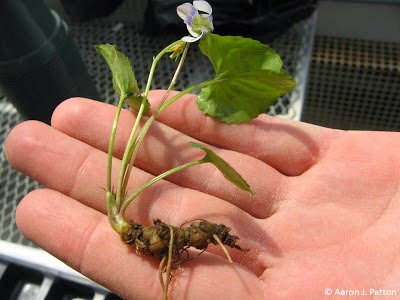
Wild violets (Viola papilionacea) are a persistent, perennial and difficult to control broadleaf plant.  For some gardeners the plant is desirable for others the plant is a weed. Plants are spread by rhizomes and seeds.

Wild violets
Some of the keys to identifying wild violets are:
  • A clumping growth habit
  • Heart shape leaves that cup toward the petiole
  • Dense fibrous root system
  • Prefers shaded site with moist fertile soil
Wild violet rhizome on soil surface


Violet rhizome after washing off soil

Controls
Violets are one of the toughest lawn weeds to control. They spread aggressively by thick, fleshy underground stems (rhizomes) that provide a large reserve of nutrients. This ability to store nutrients allows them to reappear after you attempt to kill them. Violets can be controlled, but you have to go after them aggressively and it is a process, not a one-shot treatment

For small areas hand pulling or weeding is laborious, but it’s the best way to control violets. When pulling be sure that you get the whole root, which includes the seed-bearing capsules near the soil's surface. In lawns, use a sharp knife to sever roots before pulling up the plants

Fall is the one of best times of year to control the wild violets.  Use a broadleaf killer that contains 2,4-D or Dicamba, and it will selectively kill the violets without damaging certain types of grass.  

Always, read the label before applying herbicides, it’s the law. Make sure the weed you are targeting for control is really causing a problem. Choose the right herbicide and always follow label directions when applying herbicides. The label lists the areas or locations where you can legally apply the herbicide, what protective clothing must be worn, how to mix the herbicide and other important information. Wear the protective clothing the label requires to minimize exposure during mixing, application and clean up.

Additional Information

May's Weed of the Month Wild Violets - Purdue University Extension

Wild Violet - University of Maryland Extension

Wild Violet Control - University of Nebraska


Friday, May 1, 2015

IPM Notes from April 30, 2015

After another cold winter will there be many insects this year? The previous cold winter had more snow than this past year, thereby providing a blanket covering for the insects. This past winter had less snow, but bitter cold. Time will tell how much of an insect issue there will be this year. Stay tuned. Insect traps for black cutworm, European corn borer and fall armyworm will probably be in place by next week.

On the field tour the soil temperature for covered soil and uncovered soil was 52 and 53 degrees respectively. Normally the soil temperature should be around 58 to 60 degrees for planting. Warmer weather coming this week will raise the soil temperature. Having the proper temperature, warmth and water is needed for germination. The longer the seed stays in the ground without germinating, the greater the chance there will be insect damage. If the seeds don't come up in due time, it becomes a question of economics, does the field need to be re-seeded? In the case of field corn it would be about 30,000 seeds per acre.

Next to the field corn is a grassy, weedy strip of land for pollinating plants like clover. Unfortunately this grassy, weedy area also attracts moths and their larvae. Supposedly the corn yields increase with the pollinator plants.

Beyond the cornfield, a small grain crop is growing in a no-tilled field where last year's field corn was growing. So one type of grass is growing above another, which can be more susceptible to disease and insect damage, like the cereal leaf beetle.

Various winter annual weeds were identified like henbit, purple dead nettle, bluegrass and shepherd's purse.

The strawberry plot looks very good. June bearing and ever-bearing plants were planted. . The hop plants will need to be tied-up in the near future. The hop poles and wires have been straightened and tightened. The blueberry plants have been pruned and look fairly well. The other plots are currently being worked for planting in the near future. Three of those plots were tilled a second time today.

Notes compiled by John Siemanowski

Friday, October 17, 2014

Pest of the Week - Garlic Mustard

Garlic Mustard (Alliaria petiolata) is a biennial herb in the mustard family Brassicaceae.  Garlic mustard is invasive plant native to Europe.

Garlic mustard is easily distinguished from all other woodland mustard plants by its characteristic odor of garlic and the tall flower stalks covered with numerous small white flowers in May.  The alternate, coarsely toothed, broadly triangular stem leaves with a distinct petiole are also characteristic. The garlic odor gradually dissipates by autumn, and garlic mustard rosettes may then be mistaken for violets (Viola spp.) or immature white avens (Geum canadense).

For centuries Europeans have used garlic mustard for a great variety of dietary and medicinal purposes. It is rich in vitamins A and C and makes a spicy addition to salads or cooked dishes.  It is thought that the plant was introduced to the United States by immigrants in the 1860s and was first recorded in Long Island, New York.

An average garlic mustard plant will produce 22 siliques, each of which can contain as many as 28 seeds. Studies have shown that a particularly vigorous plant may produce as many as 7,900 seeds although the average is more likely to be in the 600 seed range. The seeds generally germinate within one to two years, but may remain viable for up to five years in the seed bank. Seed dispersal is mainly by humans or wildlife carrying the seeds.

Garlic mustard exudes antifungal chemicals into the soil that disrupt associations between mycorrhizal fungi and native plants, suppressing native plant growth.  Because of this. garlic mustard has aggressively invaded numerous forested natural areas and is capable of dominating the ground layer. It is a severe threat to many natural areas where it occurs because of its ability to grow to the exclusion of other herbaceous species.


Garlic mustard flower
André Künzelmann/UFZ

Garlic mustard seedlings
DePauw University

Garlic Mustard Seed - Chris Evans


Here is a link to a short video covering all aspects of this plant in greater detail Garlic Mustard video

Because this plant is so difficult to eradicate once it is established, familiarize yourself with the flower, the plant and the habitat where it grows to find infestations early. Monitor sites regularly to remove plants prior to seed set. 

Additional Information

Garlic Mustard Video

Herbaceous Forbs - Garlic Mustard - Plant Conservation Alliance

Invasive species harms hardwoods by killing soil fungus - Harvard University

Zuwanderer unterdrücken das Wachsen einheimischer Baumarten - Helmholtz-Zentrum für Umweltforschung - UFZ

Garlic Mustard - New York Invasive Species Information


Tuesday, October 7, 2014

Pest of the Week - Pokeweed

Pokeweed (Phytolacca americana) is a native of North America and has become established in Europe. In North America, it is most common in the eastern United States and southeastern Canada. It grows as far west as Texas but is rare in the Great Lakes region. Its range extends north into Ontario and south as far as Mexico.

The scientific name for pokeweed is derived from phytos, the Latin word for plant, and lacca, which refers to the deep reddish purple of the berries. The most frequently used species name, americana, refers to its native land. The less common species name, decandra, means "having ten stamens." The common name poke is a contraction of puccoon or pocan, which the Algonquin Indians of Delaware called the familiar wild plant.

A native perennial plant that can grow up to 10' tall, branching regularly like a small tree. The stems are smooth, round, and hairless, varying from light green to brilliant purplish red. The leaves are alternate on the stem, simple, entire, with long leafstalks. Flowers are borne in elongated clusters called racemes. The pronounced clusters of berries are green when immature and ripen to a dark purple or black. Reproduction is by seeds.

Pokeweed Berries
Staff CDFA, California Department of Food & Agriculture, Botany Laboratory

Pokeweed Flowers
Brandeis University
Solitary Pokeweed Leaf
Auburn University


Because of the danger of human poisoning, pokeweed should be removed when discovered. This is especially true if the plants are in hedges, gardens, and other areas adjacent where children may be attracted by clusters of berries.

Additional Information

Forage ID Library - University of Arkansas - Cooperative Extension

Poisonous Weeds in Horse Pastures - Rutgers Univeristy - NJAES

Pokeweed - Penn State University - PennState Extension

USDA - Natural Resources Conservation Service


Friday, October 3, 2014

IPM Notes from October 2, 2014

Several weeks ago it was incorrectly stated that winter rye was growing where the sweet corn was growing. Oats are the correct cover crop that is currently growing there. The oat plants have some rust and cereal leaf beetle damage, and they will not survive the winter, unlike winter rye.

The field corn has a current moisture content of 23%. To harvest the corn the moisture level needs to be around 14%. Hopefully the corn will be harvested within the next week.

The popcorn has a current moisture content of 26.5%. Like the field corn the moisture level needs to be around 14%. As mentioned several weeks earlier the non-BT popcorn is showing plenty of corn borer damage. Some of the stalks have blown over due to the weakened stalks. The issue becomes can the popcorn dry down soon enough in order to be harvested, before incurring more damage.

The soybean show some stink bug damage, but should be ok to harvest in the near future.

In the demonstration plots the Spanish peanut crop had some foliar leaf disease and also peanut damage from voles. They are not yet ready for harvesting. The pepper plants rebounded nicely and have produced a nice crop the last couple of weeks. Also within the pepper plot the garden-in-a-bag plants have performed well this year. The ever-bearing strawberries are still producing fruit, and the June bearing plants look large and healthy. The sorghum plants have also done well this year.

There are no summaries for the insect traps. They have been taken down for the season.


Friday, September 5, 2014

IPM Notes from September 4, 2014

Winter rye is now growing in what was the sweet cornfield. More weeds are accumulating toward the backend of the field, since it is slightly lower, and more rainwater and moisture accumulate there.

The field corn is more dented. The kernel tips are beginning to get black layering, as the corn is becoming drier. The cob is still moist. The corn is expected to be harvested in about 2 weeks.

There is some concern that the popcorn, since it was planted later, may not be harvested in time. The popcorn looks healthy, but is showing some deer damage. Also, there is some corn borer damage and frass.

The high weeds noted between the popcorn and field corn were lambsquarters, spiny amaranth, jimsonweed and fall panicum.

The soybean plants look healthy and are as tall as they've ever been. The Palmer Amaranth weed mentioned last week was misidentified, so as of now there doesn’t appear to be any of these weeds at the BCCAC. This will still need to be monitored in the future. The soybean nodules look a healthy pink. The plants are showing insect damage from aphids, Japanese beetles, grasshoppers and stinkbugs, but not enough to be concerned. When a stinkbug pierces the pod, moisture and disease can result to the pod. Having many stinkbugs in the soybean plants can be a problem.

In the demonstration plots the Spanish peanut crop is beginning to show some foliar leaf disease and will need to be monitored. The pepper plants are showing some leaf drop from perhaps too much rain. The ever-bearing strawberries are still producing fruit, and the June bearing plants look large and healthy. Sulfur and water was used on the blueberries yesterday to lower the pH.

Below are the summaries for the insects caught in the three insect traps.

Trap 1 (Fall Armyworm) – 2 moths, 1 fall armyworm
Trap 2 (Fall Armyworm) –7 fall armyworm, 1 each spider & wasp.
Trap 3 (European Corn Borer – changed 8/14/14) – None