Friday, February 23, 2024

Soil: The Incredible Resource Below Our Feet

No garden can be successful without healthy soil. Often mistakenly undervalued, soil is the fundamental resource sustaining everything on earth. Plant life and the organisms that depend on plants could not survive without it. It is a living thing with many parts systematically working together. Soil provides the minerals, nutrients, biological elements, and the structure plants need to grow and thrive. But, don’t confuse soil with dirt. Dirt refers to bits of debris that are unclean or dusty. Dirt cannot support plants, whereas soil is teaming with beneficial life.

Soils start as stones that have been broken down again and again over millennia by wind and water.  Those become particles of varying size (sand, silt, and clay). Among these particles is organic matter, decaying plants, animals, and microorganisms like bacteria and fungi. Soil has pore spaces that fill with air and water.  

“In just one teaspoon of agricultural soil there can be
one hundred million to one billion bacteria,
six to nine feet of fungal strands put end to end,
several thousand flagellates and amoeba,
one to several hundred ciliates,
hundreds of nematodes,
 up to one hundred tiny soil insects,
and five or more earthworms.”
(Penn State Extension, “Soil Quality Information”, 2012.)

What are the characteristics of quality soil?

As gardeners, managing soil can be just as important as managing the plants that grow in it. Soil should do what we want it to do. Whether you are growing a vegetable crop, ornamental shrubs, or a lush lawn, paying attention to your soil’s composition and fertility is vital.

The characteristics of soil are unique.  Ideally, soil should have lots of organic matter, the capacity to hold water and air, and the ability to release nutrients to plants. It also functions to anchor plants, insulate their roots, and resist erosion.

Soil in the home garden.
Photo Credit: Alyson Ricketts, Burlington County Master Gardener


Soil can be categorized by its texture; sand, silt, clay, or loam. Sandy soil provides good drainage to plants as it lets water freely pass through, although it does not hold many nutrients. Silt particles are smoother and silkier than sand. Clay is smaller particles and holds on to water and nutrients, but can be difficult for plants roots to move through. Loam soil contains lots of organic matter and is a combination of sand, silt, and clay.

The composition of your soil depends on your location. Although soils vary widely across the state, New Jersey has a designated state soil found mostly in southern locations.  Called “Downer” soils, they are loamy, acidic, and made of coastal plain sediments. These soils are good for growing agricultural crops and sustaining many species of woodland trees. 


How do you know what is in your soil?

Thinking about soil first is an important step. Knowing the characteristics of your soil will determine your approach to planting and can help you decide what to plant and where. Some soils are ideal for specific plants and not for others. Getting your soil tested is the only way to know what’s in there. You want to know if your soil has issues that need to be corrected or if any amendments are needed.  Getting a soil test is environmentally friendly because you won’t be adding any unnecessary fertilizers that have the potential to run off and contaminate waterways. Soil tests can save money because you won’t be buying amendments you don’t need.

Rutgers Soil Testing Laboratory
Photo Credit: Rutgers New Jersey Agricultural Experiment Station

Fall is a great time to have your soil tested so you can prepare before the growing season. The first step in getting your soil tested is to purchase a test kit from the Rutgers Cooperative Extension county office or follow the sampling instructions on the website. Make sure to follow the sampling instructions carefully.  About two cups of sample soil is required from several holes, dug about 6 to 8 inches deep. Also, you will need to submit a soil questionnaire. Areas used for different types of plants should be tested separately. For example, perennial beds should be tested separately from the lawn and separately from the vegetable garden. The report will arrive in a few weeks from the time of submission by email or mail. For questions about your soil report contact the extension office.


Rutgers Soil Testing Laboratory
https://njaes.rutgers.edu/soil-testing-lab/

The soil testing lab provides testing and reports to help
New Jersey residents achieve their agricultural and environmental goals.

Soil pH

Knowing your soil pH (how acidic or alkaline) is important because plants can’t take up the nutrients they require if the pH is not within the optimal range. If the soil pH is not correct for the plant, soil amendments can be used to adjust the pH. The soil test report will indicate if limestone should be used to raise the pH or a sulfur application is needed to lower pH.  A pH of about 6.5 is optimum for most plants. Some plants have special needs, however. Blueberries, for example, prefer to grow in very acidic soil with a pH between 4.0 and 4.8.

Macronutrients and Micronutrients

Soil already has nutrients in it. A soil test will tell you what nutrients and how much it contains. Macronutrients are required by plants in larger amounts than micronutrients. Macronutrients are nitrogen (N), phosphorus (P), and potassium (K). Micronutrients are calcium, manganese, boron, zinc, and copper. Depending on the levels, composted organic matter or specific fertilizers may be needed. If applying fertilizer, use the correct type and amount. Always read the label and instructions. 


How to Care for and Maintain Soil

Keeping your soil covered with mulch, compost or a cover crop is an important step. This will help with erosion control and also add nutrients as the cover decomposes. Covering soil will help minimize weeds, retain moisture, and moderate the temperature. Try to avoid walking on soil and instead stick to walkways. Compacted soil becomes a problem because roots, water, and air cannot move through it. This is why tilling, which can compact soil, should be done in moderation. Try to avoid disturbing soil as this can bring weed seeds to the surface to germinate. Finally, use an Integrated Pest Management strategy to avoid overuse of pesticides which can kill some of the living organisms in the soil.

Additional Resources:

Rutgers Publications Fact Sheet 719: “Soil Fertility Test Interpretation”
https://njaes.rutgers.edu/pubs/publication.php?pid=FS719

Rutgers Publications Fact Sheet 797: “Soil Testing for Home Lawns and Gardens”
https://njaes.rutgers.edu/fs797/

Penn State Extension: “Soil Quality Information”
https://extension.psu.edu/soil-quality-information

Rutgers Publications Fact Sheet 1135: Soil Organic Matter
https://njaes.rutgers.edu/pubs/publication.php?pid=FS1135

New Jersey Agricultural Experiment Station: “How to Have Your Soil Tested”
https://njaes.rutgers.edu/soil-testing-lab/how-to.php

Jersey Friendly Yards: “Step 2, Start With Healthy Soil”
https://www.jerseyyards.org/create-a-jersey-friendly-yard/8-steps/step-2-start-with-healthy-soil/

Soil Science Society of America: “Soils are Living”
https://www.soils.org/files/sssa/iys/july-soils-overview.pdf

USDA Natural Resources Conservation Service: “New Jersey Soil”
https://www.nrcs.usda.gov/conservation-basics/conservation-by-state/new-jersey/new-jersey-soils

Soil Science Society of America: “Downer, New Jersey State Soil”
https://www.soils4teachers.org/files/s4t/k12outreach/nj-state-soil-booklet.pdf

Michigan State University Extension: “Soil…it’s more than dirt”
https://www.canr.msu.edu/news/soilits_more_than_dirt

Rutgers University Extension: “Digging Deeper: What’s Your Soil Telling You?”
Video: https://www.youtube.com/watch?v=O0rNVblU_08

 Brooklyn Botanic Garden: “How Compost Builds the Soil”
https://www.bbg.org/article/how_compost_builds_the_soil#:~:text=Feed%20the%20soil%2C%20not%20the,Bin%20A%20homemade%20compost%20bin.


Thursday, February 8, 2024

Some Tips on Planning a Vegetable Garden


We are in the middle of winter and winter is the best time to plan for your summer garden.  New and experienced gardeners can achieve great results by following some basic recommendations.  Here are some suggestions and resources that will guide you as you begin this year's gardening adventure.


Planning

Plan the garden on paper.  

Draw a map of the garden layout showing the location and spacing of the crops.  When planting, group tall crops (okraand sunflowers) and trellised vines (peas and beans) together on the north side of the garden so they won’t shade shorter plants.

One of the most important reasons to draw out a plan is so that you can use it in subsequent years to make sure you are rotating your crops as you should.  Vegetable crops in the same plant family should not be planted in the same area of a garden year after year.   See the table below for a list of common plant families.

Make a list of the plants that you enjoy eating and rank them in order of preference.

Keep a journal and record your thoughts and observations throughout the growing seasons.  The journal can be your reference point for what worked and what didn't work.  


Site Selection

Selecting a site for your garden:

  • The site should have good drainage.  Avoid putting the garden in an area where rain water accumulates. 
  • Easy access to water is essential.
  • Proximity to your house.  Choose a location that is easy to get to and convenient. 
  • Choose a location with a southern exposure where the plants will get plenty of sun.  Most vegetables need eight hours of direct sunlight
  • The garden should be as small as possible to reduce the amount of unnecessary work.

Garden Format

If you don’t have space for a vegetable garden or if your present site is too small, consider raising fresh, homegrown vegetables in containers. A window sill, patio, balcony, or doorstep can provide sufficient space for a productive container garden. 

Container Garden - University of Maryland Extension

Some suggestions for choosing containers:

  • Everyday objects can be recycled and used as containers.
  • Avoid dark colored containers, since they create more heat that may damage a young plant's roots.
  • Containers made of materials like clay dry out more quickly than containers made of plastic or metal.
  • Containers should have holes for draining water, unless they are self-watering.
  • Plastics not made for outdoor can become brittle.


Listed below are some recommendations for growing vegetables in containers.

Information for Growing Vegetables in Containers

Vegetable* Light Requirement**Minimum Container SizeDistance (inches) Between Plants in ContainersDays from Seed to HarvestComments
Beans, bush FS2 gal.2-345-60Several plantings, two-week intervals
Beets FS/PS1/2 gal.2-350-60Thin plants when 6 to 8 inches tall
Carrots FS/PS1 qt.2-365-80Several plantings, two-week intervals
Cabbage FS/PS5 gal.12-1865-120Requires fertile soil
Chard, Swiss FS/PS1/2 gal.4-630-40Harvest leaves for long yield
Cucumbers FS5 gal.14-1870-80Require hot weather, vining types need support
Eggplant FS5 gal.1 plant per container75-100Requires fertile soil
Kale FS/PS5 gal.10-1555-65Harvest leaves
Lettuce, leaf PS1/2 gal.4-630-35Harvest leaves
Mustard greens PS1/2 gal.4-535-40Several plantings, two-week intervals
Onions, green FS/PS1/2 gal.2-370-100Require lots of moisture
Peppers, Bell FS2 gal.1 plant per container110-120Require hot weather
Radishes FS/PS1 pint125-35Several plantings, weekly intervals
Squash, summer FS5 gal.1 plant per container50-60Plant only bush type
Tomatoes FS5 gal.1 plant per container55-100Stake and prune or cage
Tomatoes, cherry FS1 gal.1 plant per container55-100Helps to stake and prune
Turnips FS/PS3 gal.2-330-60Harvest leaves and roots


If you are not growing plants in a container the table below provides useful information for growing vegetables in New Jersey.
 
New Jersey Vegetable Planting Guide
VegetableSpacing (in.)Transplant or SeedsPlanting Dates*Avg. Yield per 10 ft. of Row
In RowBtwn. Rows
Asparagus1860CrownsPerennial5 lb.
Beans, Lima, bush424seedMa,Ju,Jl6 lb.
Beans, Lima, pole3636seedMa,Ju,Jl7 lb.
Beans, Snap, bush424seedMa,Ju,Jl6 lb.
Beans, snap., pole3624seedMa,Ju,Jl7 lb.
Beets315seedAp,Ma,Ju,Jl14 lb.
Broccoli1530transplantAp,Ma,Jl,Au8 heads
Brussels Sprouts1830transplantJl5 lb.
Cabbage1824transplantAp,Jl7 heads
Cabbage, Chinese1218seed or trp.Ap,Jl10 heads
Carrots315seedAp,Ma,Ju,Jl10 lb.
Cauliflower2430transplantJl5 heads
Celery618transplantMa,Ju20 stalks
Chard, Swiss624seedAp,Ma,Ju,Jl,Au20 plants
Collards1824seedAp,Ma,Ju,Jl10 lb.
Corn, Sweet1224seedMa,Ju10 ears
Cucumbers3630seed or trp.Ju,Jl8 lb.
Eggplant3030transplantMa,Ju20 fruit
Endive1218seed or trp.Ap,Ma,Ju,Jl,Au10 plants
Kale1518seedJl,Au24 lb.
Kohlrabi415seed or trp.Ap,Ma,Jl,Au20 bulb.
Leeks315transplantsAp,Ma,Au40 plants
Lettuce,Leaf,Romaine815seed or trp.Ap,Ma,Au,Se15 heads
Lettuce, Bibb615seed or trp.Ap,Ma,Au,Se20 heads
Muskmelons3672seed or trp.Ju8 melons
Mustard Greens1215seedAu10 lb.
Okra2436seedMa,Ju100 pods
Onions, dry415seed,trp.setsAp10 lb.
Parsley615seedAp,Ma,Ju20 bunches
Parsnips318seedAp10 lb.
Peas218seedMr,Ap3 lb.
Peppers1515transplantJu12 lb.
Pumpkins4896seedJu4 fruit
Radishes112seedAp,Ma,Ju,Jl,Au,Se60 roots
Rhubarb3648crownsPerennial20 stalks
Rutabagas418seedsAp,Jl15 lb.
Spinach418seedsAp,Se7 lb.
Squash, bush2448seeds or trp.Ju,Jl25 fruit
Squash, vine3672seeds or trp.Ju20 fruits
Sweet Potatoes1236transplantsJu12 lb.
Tomatoes2436transplantsMa,Ju50 lb.
Turnips318seedAp,Jl7 lb.
Watermelons3696seedJu3 melons
White Potatoes1224tubersAp18 lb.

*Mr=March; Ap=April; Ma=May; Ju=June; Jl=July; Au=August; Se=September

Many new vegetable varieties of vegetables are constantly being developed.  Before purchasing vegetable plants read the label carefully,  note the growing conditions, date to maturity, resistance to disease and pests.

Some common vegetables and their plant family classifications.

PLANT FAMILYVEGETABLE
Carrot Family (Apiaceae)carrot, celery, parsley, parsnip
Goosefoot Family (Chenopodiaceae)beet, spinach, Swiss chard
Gourd Family (Cucurbitaceae)cucumber, muskmelon, pumpkin, summer squash, watermelon, winter squash
Grass Family (Poaceae)ornamental carn, popcorn, sweet corn
Mallow Family (Malvaceae)okra
Mustard Family (Brassicaceae)broccoli, Burssels sprouts, cabbage, cauliflower, Chinese cabbage, collard, kale, kohlrabi, mustard greens, radish, rutabaga, turnip
Nightshade Family (Solanaceae)eggplant, pepper, potato, tomato
Onion Family (Alliaceae)chives, garlic, leek, onion
Pea Family (Fabaceae)bush bean, kidney bean, lima bean, pea, pole bean, soybean
Sunflower Family (Asteraceae)endive, lettuce, sunflower

Test and Prepare the Soil

Example of a soil test kit

Soil testing is an easy, quick and accurate method to determine the relative acidity of the soil. The test will also measure the level of some essential nutrients (phosphorus, potassium, calcium, magnesium, sodium, sulfur, manganese, copper, and zinc) needed for healthy plant growth. Samples for planting and gardening projects should be submitted several weeks before you plan to plant. This will allow plenty of time for you to get the results back and if necessary, amend the soil before planting.  The results from the test will aid you in plant selection, soil preparation, and fertilization. The test results will help you avoid overfertilization, which can stimulate excessive plant growth and increase the likelihood of some diseases. Applying the correct grade and amount of fertilizer can also help reduce pollution of our water supplies and allow you to have healthier, more productive plants.


Irrigation

Generally speaking, most vegetable crops grow best if they receive about an inch of rainfall per week through the growing season. In a season with regular rainfall, supplemental irrigation may not be necessary except when first transplanting young plants into the garden. However, in a dry year, access to irrigation may be needed. Many gardeners irrigate overhead (with a hose and nozzle attachment or with a sprinkler system) or using drip irrigation (using soaker hoses).   Drip irrigation is the most efficient method for irrigation.  In drip irrigation systems the water is slowly released at the garden's surface through plastic tubing with tiny holes.  Reliable and convenient access to a source of water is critical to the success of your garden.


Integrated Pest Management (IPM)

IPM is method that can be used to manage weeds and other pest in a garden.  What is IPM?  IPM is a "science-based decision-making process that combines tools and strategies to identify and manage pests".  In a garden, a pest is any organism (plant or animal) that interferes with the growth of the vegetables in your garden.  

Factsheet from the Entomological Society of America 

Weed Control

Weeds are a constant problem for all gardeners.  Weeds compete with the plants in your garden for nutrients and resources.  Weeds can also introduce insect pests and diseases into the garden.  Effective weed control is essential for ensuring that your garden will have healthy and productive plants.  Weeds can be managed with mechanical, chemical, mulch and weed fabric.

Mechanical 

You can control weeds by cultivation and periodically hand pulling the weeds throughout the growing season.  Begin your control efforts early in the growing season when the weeds are small and easier to eradicate.  If cultivating avoid deep tillage since it brings more weeds to the surface and can cause the soil to dry out more rapidly.

Chemical

Organic herbicides (pesticides used to control weeds) and non-organic herbicides can also be used to control the weeds in your garden.

There are basically two types of herbicides: pre-emergent and post-emergent.  Pre-emergent herbicides control the germinating seeds before plants emerge from the soil. They won’t control weeds that have already emerged and are growing in the garden.  Post-emergent herbicides are used to control weeds that have already emerged. The younger the weed, the better chance that a post-emergence herbicide will work.  In addition to herbicides being pre or post-emergent, herbicides can also be non-selective and selective.  Herbicides that kill most plants they contact are called non-selective.  While herbicides that control some kinds of plants but not others are called selective herbicides.

A few things to remember

  • Always identify the weed you are trying to control.  
  • Check that the herbicide label lists the weed you are trying to control.  
  • Verify that the weed is in a stage that can be controlled by the herbicide.  
  • Make sure that the herbicide is safe to use around the other plants in your garden.  
  • Remember, a non-selective herbicide will kill all plants susceptible to the herbicide and not just weeds.

Always, try to minimize the use of pesticides that pollute our waterways. Whenever possible use non-chemical alternatives or less toxic pesticide products . Read product labels carefully and follow instructions on the proper use, storage and disposal.

Mulch

Mulch is an effective way to help prevent weeds in gardens. Mulch can be defined as an applied barrier of some form of organic matter. 

Benefits of Mulching 
  • Reduces soil evaporative water losses. 
  • Increases soil temperature 
  • Controls or suppresses weeds 
  • Reduces nutrient leaching during heavy rainfall. 
  • May add nutrients to soil (organic mulches)

New plantings should be mulched immediately after planting. Early spring is ideal, as this conserves existing soil moisture during the period when plants are coming out of winter dormancy.  Early season application also prevents many weed seeds from germinating or emerging through the mulch if mulch is applied at recommended depths for the particular material selected. 

Weed the area well before applying mulch.  Then spread mulch over the entire planting area. Keep mulch 2-3 inches away from the base of plants to prevent conditions that encourage diseases or attract rodents. Do not form a "mulch volcano" at the bottom of the plant.  This practice provides shelter for voles in particular, which eat bark and can girdle plants entirely, resulting in plant damage or death. 

Weed Fabric 

Weed fabrics are materials woven of fabric, plastic, or paper, The fabrics are available in various lengths and widths. The materials are usually treated to resist decomposition. The fabric's materials are constructed to allow water and air to move through the fabric. Weed barriers work well on most weeds, although some grasses may grow up through the holes in the fabric. Weed fabric and landscape cloth work best when they are pinned down so that weeds cannot lift up fabric. Moisture, temperature, and weed control can be improved by adding several inches of another organic mulching material on top of the weed fabric/landscape cloth.


Additional Information

Soil Testing Lab - Rutgers University - NJAES

Lamb Brothers System of Container Gardening - University of Arkansas Cooperative Extension

Raised Bed Gardens - University of Minnesota Extension

Soil for Raised Bed Gardens - Rutgers University - NJAES

Planning a Vegetable Garden - Rutgers University - NJAES

Drip Irrigation for Home Gardens - Colorado State Extension

New Jersey Weed Gallery - Rutgers University - NJAES

Weed Management - University of Illinois Extension

Weed Control for Vegetable Gardens - University of Georgia Extension

Mulches for Vegetable Gardens - Rutgers University - NJAES

New Jersey Invasive Strike Team - Herbicide Use Suggestions - FoHVOS

Integrated Pest Management - UC Davis - SAREP


Friday, January 5, 2024

At Home with Houseplants

On a cold dark day in January, the green and cream striped leaves of the ‘Birkin’ philodendron are a welcome sight.  As are the jagged fleshy spikes of the succulent aloe. Or perhaps it’s the soft ovate leaves and colorful flowers of the African violet that gives us a sense winter won’t last so long after all. The somewhat finicky ficus has many enthusiastic followers as do tropical indoor ferns. Anyone can benefit from keeping an indoor garden and a myriad of plants will grow in interior environments.  However, there is one thing that every indoor plant has in common--they all need the right conditions to thrive. Taking proper care of them is not so daunting once you know how.


Birkin philodendron (Philodendron ‘Birkin’) is a compact variety with white stripes on its leaves. Philodendron come in both climbing and non-climbing types. This plant is an easy to care for houseplant, requiring medium light and can even tolerate some neglect. Photo credit: Iowa State University Extension and Outreach


Not only do houseplants beautify our homes, but they provide a host of other benefits as well. Plants can help us emotionally by connecting us with nature at times when going outside is difficult. Plants take in carbon dioxide and in turn provide us with fresh oxygen. Indoor plants serve as décor for our homes and some, like a potted citrus tree, can even provide us with food.

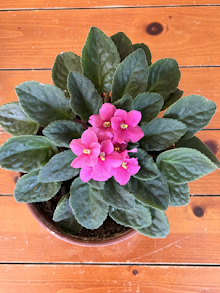
Potted African violet (Saintpaulia ionantha) with pink flowers. African violets prefer indirect light and moist soil conditions. Credit: Alyson Ricketts, Burlington County Master Gardener

Aloe (Aloe vera) with “pups”. Propagate aloe by removing the pups from the main plant and repotting them. Aloe needs bright light and sandy soil that dries out between waterings. “Gel” from the aloe plant can be used to heal skin irritations. Credit: Alyson Ricketts, Burlington County Master Gardener

Many typical houseplants are tropical plants that evolved in natural understory environments with plenty of humidity and dappled shade. For example, the exotic looking holiday cacti (Shlumbergera species) evolved in the mountainous rainforests of South America. They need high humidity, bright but filtered light, and moist well-drained soil. It is important to keep in mind the needs of houseplants regarding light, water, temperature, and fertilizer.  It is also important to know how to deter pests. Take a look at the label when you buy your plant, it will have important information about how to properly care for it.


Christmas Cactus in Bloom 
Credit: University of Minnesota Extension

Location/Light Requirements:

The old gardener’s adage of “right plant for the right place” applies to houseplants as well as outdoor plants. Choose a location that provides the right amount of light for the plant you are growing. Some houseplants prefer direct southern sunlight while others can tolerate a darker corner. Keep in mind that many plants need bright, but indirect light. Ideally house plants should receive natural light from a window, but grow lights can also be used.

Watering:

Know your plants water requirements. Overwatering is the most common mistake gardeners make. Most houseplants need good drainage, they do not like to sit in water-logged soil. Indoor gardeners, especially when the heat inside is running continuously, are afraid their plants will dry out. However, paying attention to soil moisture in the pot will help to adequately gauge if the plant needs to be watered.  Stick a finger in the soil up to the first knuckle to determine how much water is still in the soil. A water meter for plants can be handy as well. Another trick is to lift the pot to see if it feels light or heavy with water. Use room temperature water to not shock the plant.

Most houseplants like humidity. Consider running a humidifier to provide extra moisture in the air. Grouping plants together can help as well as filling a tray with water for evaporation. Misting with a spray bottle may help some, but its effects are short lived.

Temperature:

In general, houseplants enjoy the same temperatures as people do, 60-80 degrees during the day and 5-10 degrees lower at night. Some houseplants will enjoy a vacation outside during the summer months, but bring plants back inside when the weather gets colder.

Fertilizing and Repotting:

Fertilize when plants are growing. In the late spring and summer warmer temperatures and increased light promote growth. Some plants, like succulents though, don’t need any high nitrogen fertilizer.

Spring is the best time to transplant or re-pot your houseplants. Check to see if plants have become root-bound and provide a larger pot. Use any soil or soil-less potting medium that is suitable for houseplants. Do not use soil from outdoors as it could be a source of pests.

Pests and Diseases:

Even indoor plants have to combat pests at times. Common pests are mealybugs, mites, scale, fungus gnats, and whitefly. The first step is to identify the pest. Additionally, some fungal diseases can cause root and stem rot as well as spots on the leaves. If you can, change the conditions that favored the pest or disease in the first place. Maybe your soil remained too wet or the plant was stressed because it didn’t get enough water. Perhaps the pest was able to thrive in hot, dry air. At times it may be necessary to clean the foliage. Use a wet cloth to wipe away dust and dirt from the leaves.


If you are a gardener who would be happy if your Monstera grew into a monster (they can grow 16 feet or more), do your research and give your plant the conditions it requires. A range of plants are available for a variety of indoor environments. Choose the one (or many!) that will work best for you. With the right knowledge, indoor gardeners can surely make their plants feel right at home.

Additional Resources:

Cornell Cooperative Extension, “Houseplant Care”

https://allegany.cce.cornell.edu/gardening/houseplant-care

Indoor Gardens: Just for the Health of It by Joel Flagler

https://sebsnjaesnews.rutgers.edu/2022/09/indoor-gardens-just-for-the-health-of-it/

Penn State Extension, “Caring for Houseplants”

https://extension.psu.edu/caring-for-houseplants

Clemson Cooperative Extension Home and Garden Information Center, “Common Houseplant Insects and Related Pests”

https://hgic.clemson.edu/factsheet/common-houseplant-insects-related-pests/

University of Connecticut, “Fertilizing Houseplants”

https://s3.amazonaws.com/assets.cce.cornell.edu/attachments/18531/FertilizingHouseplants.pdf?1478879035

The Real Dirt Blog by the UC Master Gardeners of Butte County, “Cactus from the Rainforest: Christmas Cactus”

https://ucanr.edu/blogs/blogcore/postdetail.cfm?postnum=50947

Penn State Extension, “African Violet Care”

https://extension.psu.edu/african-violet-care

University Of New Hampshire, “What Should I Know About Growing Aloe at Home?”

https://extension.unh.edu/blog/2019/01/what-should-i-know-about-growing-aloe-home

North Carolina Extension Gardener Plant Toolbox, “Monstera Deliciosa”

https://plants.ces.ncsu.edu/plants/monstera-deliciosa/


Friday, May 31, 2019

Welcome to Mosquito Season

With the unofficial start of summer, now is a good time to start planning to reduce the number of mosquitoes around your home. Worldwide there are approximately 3500 species of mosquitoes.  They live in almost every region of the earth from subarctic to the tropics. As of 2015,  63 species of mosquitoes were found in New Jersey.  Mosquitoes are members of the order Diptera.  The word Diptera comes from the Greek di which means two and ptera which means wing.  The order Diptera also includes the common housefly.

Like other true flies, mosquitoes undergo a complete metamorphosis: egg, larva, pupa and adult.  The larvae are anatomically different than the adult mosquito, it lives in a different habit and feeds on different nutrients.  The pupa is a non-feeding stage.
Mosquito life cycle - Knox County Tennessee
Mosquito larvae are uniquely adapted for aquatic life.  They need oxygen for respiration and water-borne particles for food.  The larva feed on micro-organisms and organic material in the water where they breed.

Mosquito Larvae Videos from the University of New Hampshire - Center of Freshwater Biology
Both the male and female mosquito get their protein from nectar.  The female mosquito feeds on blood to obtain the nutrients she needs to produce eggs.  The reaction to the saliva that the female mosquito injects when feeding is what causes itching.  Depending on the species a female mosquito may lay between 50-500 eggs.

The illustration below from a CDC(Centers for Disease Control and Prevention) manual shows three of the most common mosquito genera and some of their chief characteristics.

ANOPHELES AEDES CULEX


This interesting photograph shows the proboscis of a mosquito.  The proboscis is the mouth part of the female mosquito that is used for sucking blood.

Mosquito proboscis - Copyright © 2015 Choo, Buss, Tan and Leal. Creative Commons Attribution License (CC BY). Front Physiol. 2015; 6: 306. Published online 2015 Oct 29. doi: 10.31389/fphys.2015.00306


Sometime insects like the one pictured below are mistaken for mosquitoes.  The easiest way to tell the difference between a crane fly and a mosquito is by observing the mouth parts.  

Crane fly - notice the missing proboscis - Texas A&&M AgriLife Extension
Control

Water is necessary for mosquito development.  By eliminating sources of standing water, the number of mosquitoes will be reduced.  Listed below are some of the common methods that you and your neighbors can use to reduce the sources of standing water and control the mosquito population in your neighborhood.
  • Remove old tires or drill holes in those used for playground equipment to allow them to drain. 
  • Check boats for holding water, clear drain holes, turn over, cover or increase angle to aid drainage.
  • Check tarps on boats or other equipment/items that may collect water in pockets or indentations.
  • Remove vegetation or obstructions in drainage ditches that prevent the flow of water.
  • Pick up broken, unused or discarded toys that hold water.
  • Pick up all beverage containers and cups.
  • Replace water in birdbaths once a week.
  • Replace water in pet and other animal feeding dishes or troughs at least once a week.
  • Fill tree holes (hardwood trees) that hold water with spray, insulating foam sealant.
  • Position garbage cans and lids so they don’t hold water.
  • Change water in planters, including hanging plants, at least once a week.
  • Maintain gutters so water drains properly.
  • Monitor all types of drainage pipes/systems for standing water.
  • Fix dripping outdoor faucets that create pools of water.

Female mosquitoes find a host by using a combination cues like CO2,  vision and thermal sensory information to detect body heat.  Mosquito repellents are used to block a female mosquito's ability to detect a host.  Listed below is a table the summarizes the effectiveness of various mosquito repellents.

Table 1. Summary of effectiveness of mosquito repellents reported by Fradin, M. S. and J. F. Day. 2002. Comparative efficacy of insect repellents against mosquito bites.  New England Journal of Medicine 347: 13 – 18.
Product1Active IngredientMinutes of Complete
Protection
Evaluation2
Off! Deep Woods23.8% Deet302A
Sawyer Controlled Release20% Deet234B
Off! Skintastic6.7% Deet112C
Bite Blocker for Kids2% Soy oil95D
Skin-So-Soft Bug Guard Plus7.5% IR353523E
Natrapel10% citronella20E
Herbal Armor12% citronella
2.5% peppermint oil
2% cedar oil
1% lemongrass oil
0.05% geranium oil
19E
Green Ban for People10% citronella
2% peppermint oil
14E
Buzz Away5% citronella14E
Skin-So-Soft Bug Guard0.1% citronella10E
Skin-So-Soft Moisturizing Sun Care0.05% citronella3F
Gone Original Wristband9.5% Deet0.3G
Repello Wristbande9.5% Deet0.2H
Gone Plus Repelling Wristband25% citronella0.2H
1May or may not be available for purchase or registered for use in New Jersey.
2Letters indicate groups of repellents that are statistically similar; e.g., the six repellents in category E are statistically similar to each other.

By eliminating the larval habitats on your property and taking a few simple precautions, you can reduce the threat of mosquito-borne illness and annoyance in and around your home and neighborhood.


Additional Information

Bti for Mosquito Control - US Environmental Protection Agency

Crane flies, not mosquitoes - Texas A&M AgriLife Extension

Macroinvertebrate Resources - Stroud Center Water Resources

The American Mosquito Control Association

The Asian Tiger Mosquito - Center for Vector Biology - Rutgers University

Burlington County Mosquito Control Division


References
Anonymous, 1967. CDC Manual. Pictorial Keys. Arthropods, Reptiles, Birds and Mammals of Public Health Significance. US/HEW, Public Health Service. 192 pp.


Sunday, March 3, 2019

Asian Longhorned Tick - A New Invasive Species

There is a new invasive species in New Jersey: the longhorned tick (Haemaphysalis longicornis).  The longhorned tick is a member of the family Ixodidae which means that it is a hard tick.  Hard ticks have three distinct life stages.  Depending on the temperature, the tick's eggs usually hatch between 60-90 days.  When the larva emerge from the eggs they have three sets of legs.  After having a blood meal they molt and become nymphs and acquire four sets of legs.  Nymphs feed for approximately 7 days and detach.  The nymph then spends about 40 days living under the vegetation before molting and becoming an adult which also has four sets of legs.
Larva (Source: lucidcentral.org)
Nymph (Source: lucidcentral.org)
Male (Source: lucidcentral.org)
The longhorned tick finds a host using a behavior called "questing".  A questing tick crawls up the stems of grass or perches on the edge of leaves.  When the tick detects a host it uses its extended front legs to attach itself to the host.
Questing Tick
Credit: Graham J. Hickling, The University of Tennessee. Public domain.

After having fed on a host for about seven days, the female detaches itself and begins searching for a suitable place to lay eggs.  Within 1-2 weeks the female tick will lay around 2,000 eggs during a 2-3 week period.  Because the longhorned tick is a parthenogenesis species, it can reproduce asexually.  The female does not require a male tick to reproduce.

While the longhorned tick is new to New Jersey it has been a pest in New Zealand for decades. In New Zealand the tick has been found on the following animals.

Mammals
  • Brushtail possum (Trichosurus vulpecula),
  • Cat (Felis domesticus),
  • Cattle (Bos taurus),
  • Dog (Canis familiaris),
  • Donkey (Equus asinus),
  • Goat (Capra hircus),
  • Horse (Equus caballus),
  • House mouse (Mus musculus),
  • Pig (Sus scrofa),
  • Rabbit (Lepus cuniculus),
  • Sheep (Ovis aries)
Birds
  • Dosmestic duck (Anas boscas var),
  • Domestic fowl (Gallus gallus),
  • House sparrow (Passer domesticus),
  • Kiwi, Pheasant (Phasianus colchicus),
  • Skylark (Alauda arvensis),
  • Thrush (Turdus philomelus),
  • Turkey (Meleagris gallipavo)
Prevention
Most tick bites can be prevented.   Some of the simple things you can do to prevent exposure to ticks are:


  • Avoid areas bushy and grassy areas where ticks normally live.
  • Wear light colored clothing which makes it easier to identify ticks.
  • Wear clothing and boots that have been treated products containing 0.5% permethrin.
  • Use Environmental Protection Agency (EPA) registered insect repellants.
  • Walk in the center of trails.
  • Check you clothing and body for ticks after you have been outside.
  • Shower soon after you have been outdoors.


Tick Removal
Removing a tick isn't difficult.  Here are the simple steps for removing a tick:


  1. Use a pointed tick removal tweezer
  2. Disinfect the area with rubbing alcohol
  3. Grab tick close to skin and use slow, steady motion to pull tick out
  4. Disinfect the area again
  5. Consider Tick Testing for infection

Here is a short video that demonstrates the proper method for removing a tick.


Identification
If you find a tick you can bring it to the Rutgers Cooperative Extension office located at 2 Academy Dr, Westampton, NJ 08060 for identification. Ticks should be placed in a sealed plastic bag or a container with a small piece of moist paper towel to prevent dehydration.


Additional Information

Tick Bites Prevention - Centers for Disease Control and Prevention

How to Recognize a Longhorned Tick - Center for Vector Biology, Rutgers University

Tick Biology - UC Davis, Department of Entomology and Nematology

TickEncounter Resource Center - University of Rhode Island

Zoogeography of the New Zealand Tick Fauna - University of Wellington, New Zealand